Recipes are usually written for 1500–1800W air fryers; at 1200–1499W add about 10–15% to the time, and at 800–1199W add 20–30%. Your wattage is on the sticker on the back of the machine. The chart below does the math for 13 common foods.
Ever followed an air fryer recipe exactly and your food came out pale or underdone? The recipe isn’t necessarily wrong. Your air fryer’s wattage might just be different from the one the recipe was written for.
Step 1: Find your wattage
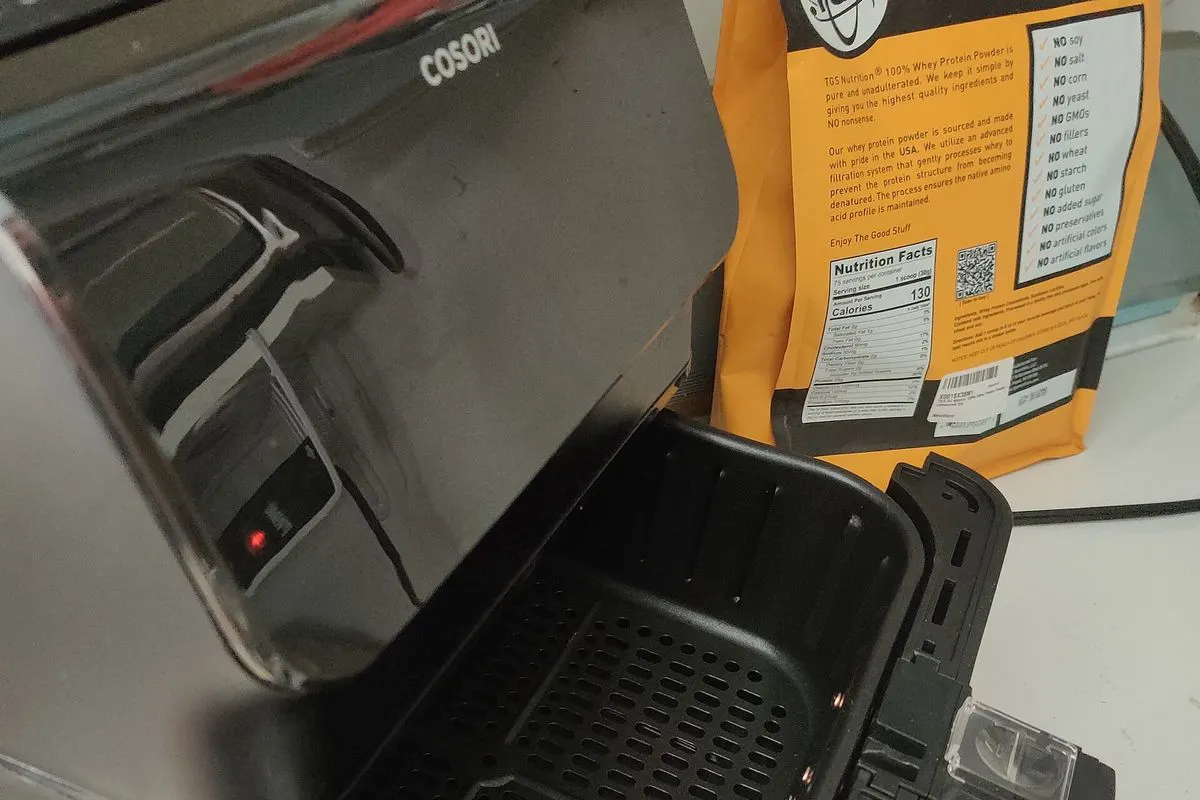
Turn your air fryer around (or tip it carefully) and find the rating sticker. Look for a number followed by W — for example, 1700W. You’ll also find it in the manual or on the box.
Most air fryers fall somewhere between 800W and 1800W:
| Air fryer type | Typical wattage |
|---|---|
| Compact 2–3 qt | 800–1200W |
| Mid-size 4–5 qt | 1200–1500W |
| Standard 5.8–6 qt | 1500–1800W |
| Large 8 qt / dual basket / oven-style | 1700–1800W+ |
Read next: Air Fryer Cooking Times Chart for 40+ Foods
Step 2: Adjust the time
The recipes on this site (and most online) are written for a standard 1500–1800W air fryer. Use this as a starting point:
| Your wattage | Adjust cooking time |
|---|---|
| 1500–1800W | Recipe time as written |
| 1200–1499W | Add about 10–15% |
| 800–1199W | Add about 20–30%, and cook smaller batches |
Keep the temperature the same and change only the time. These are guidelines, not exact math: food size, how full the basket is and the starting temperature all matter. Check early and use a thermometer for meat.
Printable chart: common foods by wattage
| Food (temp) | 1500–1800W | 1200–1499W | 800–1199W |
|---|---|---|---|
| Frozen fries, thin (400°F / 200°C) | 12–16 min | 14–18 min | 15–20 min |
| Homemade fries (380°F / 195°C) | 15–20 min | 17–23 min | 19–26 min |
| Chicken wings (380°F / 195°C) | 22–25 min | 25–29 min | 27–32 min |
| Boneless chicken breast (375°F / 190°C) | 18–22 min | 20–25 min | 22–28 min |
| Breaded chicken tenders (400°F / 200°C) | 11–13 min | 12–15 min | 14–17 min |
| Salmon fillet, 1” (390°F / 200°C) | 8–10 min | 9–11 min | 10–13 min |
| Burgers, 1/4 lb (370°F / 185°C) | 8–10 min | 9–11 min | 10–13 min |
| Bacon (350°F / 175°C) | 8–12 min | 9–14 min | 10–15 min |
| Brussels sprouts, halved (375°F / 190°C) | 14–16 min | 15–18 min | 17–21 min |
| Broccoli florets (375°F / 190°C) | 8–10 min | 9–11 min | 10–13 min |
| Potato wedges (400°F / 200°C) | 18–22 min | 20–25 min | 22–28 min |
| Frozen nuggets (400°F / 200°C) | 8–10 min | 9–11 min | 10–13 min |
| Reheat pizza slice (350°F / 175°C) | 3–4 min | 3–5 min | 4–5 min |
Meat is done by temperature, not time: chicken 165°F (74°C), ground meat 160°F (71°C), steaks, chops and fish 145°F (63°C).
Print tip: use your browser’s print button — the menus and ads are hidden automatically when you print.
Holiday foods by wattage
Long cooks stretch the most on low-wattage machines, so these are worth planning before Thanksgiving or Christmas. Big roasts also need a basket that fits them, which usually rules out compacts.
| Food (temp) | 1500–1800W | 1200–1499W | 800–1199W |
|---|---|---|---|
| Turkey breast, 3 lb boneless (350°F / 175°C) | 55–65 min | 60–75 min | Too big for most compacts |
| Fully cooked ham, 3 lb, wrapped (320°F / 160°C) | 36–42 min | 40–48 min | Too big for most compacts |
| Green bean casserole, 7-in dish (350°F / 175°C) | 13–14 min | 14–16 min | 16–18 min (if the dish fits) |
| Candied sweet potato cubes (380°F / 195°C) | 16–18 min | 18–21 min | 19–23 min |
| Reheat turkey slices in foil (300°F / 150°C) | 5–8 min | 6–9 min | 6–10 min |
| Dinner rolls, reheat (300°F / 150°C) | 3–4 min | 3–5 min | 4–5 min |
Turkey and reheated leftovers are done at 165°F (74°C), a fully cooked plant-sealed ham at 140°F (60°C). A slower machine doesn’t change those numbers. It just takes longer to reach them.
Don’t turn the temperature up to make up for low wattage
It’s tempting to set a 1,000 W air fryer 25°F hotter to “catch up.” On thin foods like fries that can work, but on anything thick it backfires: the outside browns faster while the center still heats at the same slow pace, and you get dark chicken that’s under temperature inside. Keep the recipe temperature and add time instead.
Is your dial telling the truth?
Wattage isn’t the only variable; the thermostat can be off, too. To check, put an oven thermometer on the crisper plate, set the air fryer to 350°F (175°C), and read it after 10 minutes. If it’s more than about 15°F (8°C) off, set the dial up or down by the difference. Check again after a month; a reading that keeps drifting is a reason to contact the manufacturer.
Worked examples
- A 1,000 W, 3-qt compact and a recipe that says “wings, 380°F, 22–25 minutes.” Add 20–30%: start checking at about 27 minutes, expect up to 32. Cook 1 lb (450 g) at a time instead of the 1.5–2 lb a big basket holds.
- A 1,400 W, 4.5-qt and frozen thin fries, “400°F, 12–16 minutes.” Add 10–15%: check at 14, done by about 18. Shake at 7.
- A 1,700 W oven-style and boneless chicken breast, “375°F, 18–22 minutes.” Use the recipe time, but swap trays halfway; the top rack may finish 2–3 minutes sooner. The chicken is done at 165°F (74°C), the minimum on the USDA safe temperature chart, whatever the clock says.
- A 1,750 W, 8-qt basket and 2.5 lb (1.1 kg) of halved Brussels sprouts, “375°F, 14–16 minutes.” The wattage is high, but at about 220 W per quart a full basket is a heavy load. Either split it into two batches at the recipe time, or plan on 20–24 minutes with two shakes and accept a little less browning.
Watts per quart: the number that actually predicts speed
Total wattage is only half the story. A small heater in a small basket can heat food as fast as a big heater in a big basket. Divide watts by quarts and you get a better sense of how hard each machine works on a full basket:
| Example machine | Watts | Quarts | Watts per quart |
|---|---|---|---|
| Compact basket | 1,000 | 2 | 500 |
| Compact basket | 1,200 | 3.7 | about 325 |
| Mid-size basket | 1,500 | 5 | 300 |
| Standard basket | 1,700 | 5.8 | about 295 |
| Large basket | 1,750 | 8 | about 220 |
| Oven-style | 1,800 | 10 (or more) | 180 or less |
What this means in the kitchen:
- Small baskets are not always slow. A 1,000 W, 2-qt model cooking a single chicken breast can match a 1,700 W, 6-qt. It only falls behind when you ask it to cook a full load.
- Big baskets and oven-styles need lighter loads. At around 200 W per quart, an 8-qt basket packed to the top cooks noticeably slower than the same food spread thin. Use the space for a single layer, not for piling.
- The recipe tables above assume roughly 280–300 W per quart, which is where most 5–6 qt, 1,500–1,800 W baskets land.
Calibrate your own air fryer in 15 minutes
Charts can only estimate. To find out how your machine actually compares, run one cheap test:
- Preheat to 400°F (200°C) for 3 minutes.
- Spread 8 oz (225 g) of frozen thin-cut fries in a single layer. Use the same brand you normally buy.
- Shake at 6 minutes, then check every minute from 10 minutes on.
- Note the minute they’re golden and crisp.
A typical 1,500–1,800 W basket gets there in about 12–14 minutes. Divide your time by 13 to get your multiplier. If yours took 16 minutes, that’s about 1.25: multiply recipe times by 1.25 and check early. Write it on a piece of tape on the machine.
Wattage, outlets and the breaker
Wattage also tells you how much current the air fryer pulls. At 120 volts, a 1,700 W air fryer draws about 14 amps; an 1,800 W model about 15 amps. A standard US kitchen circuit is 15 or 20 amps. That’s why the breaker trips when the air fryer and a toaster, kettle or microwave run on the same circuit at once.
- Plug the air fryer straight into a wall outlet, not a power strip or a light-duty extension cord.
- On a big cooking day, put high-wattage appliances on outlets on different circuits.
- In Australia, appliances run on 230–240 volts, so a 1,700 W air fryer draws only about 7 amps; the wattage-to-time rules above still apply the same way.
The listed wattage is the heater’s maximum. Once the basket reaches temperature, the thermostat cycles the heater on and off, so the real energy use over a cook is lower than watts × minutes. For what that means on your bill, see air fryer vs. oven electricity cost.
Other reasons your times don’t match
- Overcrowded basket: the biggest one. Cook in a single layer.
- No preheat: add 2–3 minutes, or preheat for short cooks.
- Cold food from the fridge: takes a little longer than room temperature.
- Thicker pieces than the recipe: a 12-oz chicken breast is not an 8-oz one. Past 1.5 inches thick, lower the heat 25°F and add time (thickness table).
- Oven-style models: top rack cooks faster than the bottom; swap trays halfway.
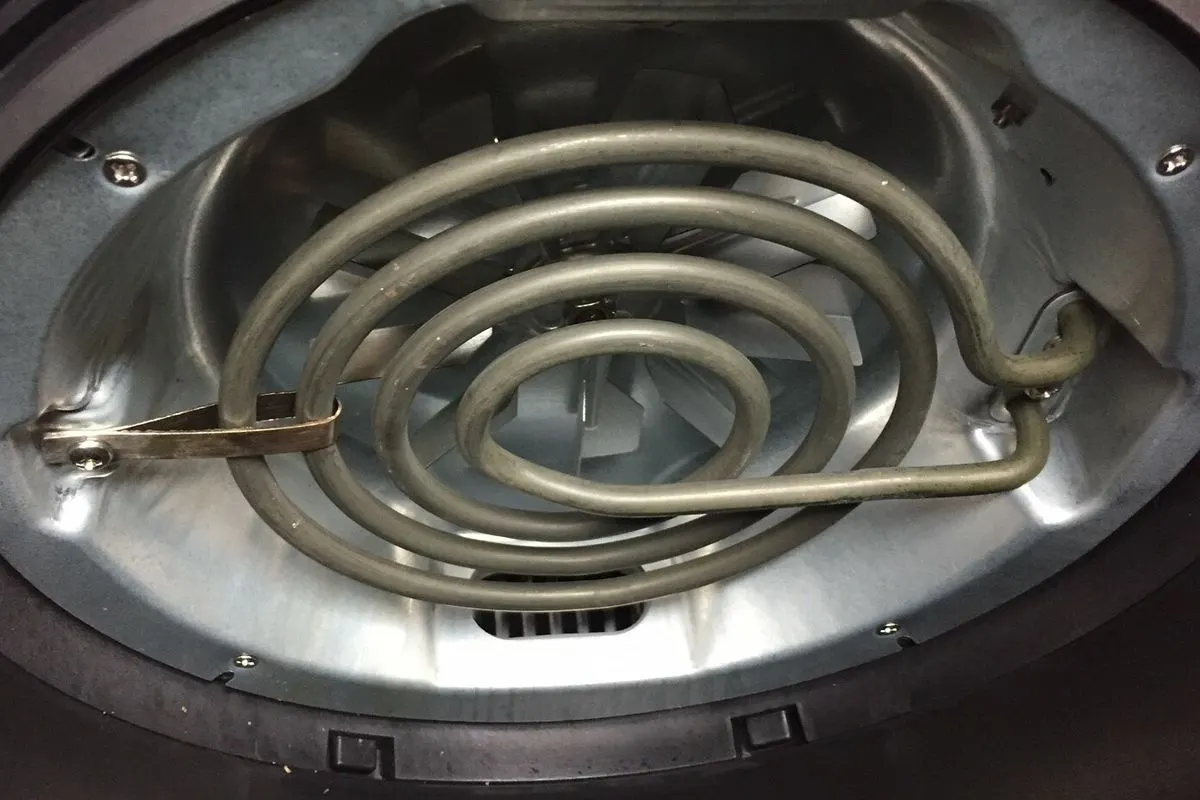
- Dirty heating element: grease build-up can affect performance — deep clean it.
Also see: our full air fryer cooking times chart with 50+ foods in °F and °C.
FAQ
Where do I find my air fryer's wattage?
On the rating sticker on the back or bottom of the unit (look for a number followed by W), in the manual, or on the original box or product page.
Does higher wattage mean a better air fryer?
Not necessarily better, but usually faster heating and better crisping, especially in larger baskets. A 1700W 6-quart and a 1000W 2-quart can cook small batches similarly; the bigger the basket, the more wattage matters.
Does wattage affect electricity cost?
Higher wattage uses more power per minute, but it also cooks faster. Air fryers generally use less energy than heating a full-size oven for small batches.
Sources
We check temperatures and safety advice against these official sources. Spotted something wrong? Email [email protected].